Principle of Operation
Electromagnetic Condition Scanning
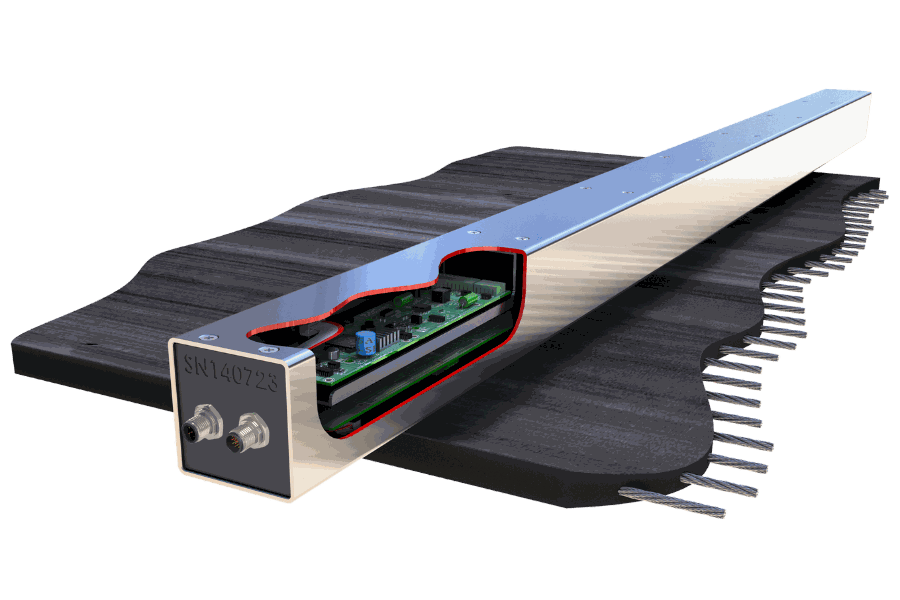
Two permanent magnet arrays (conditioning heads) are permanently installed above and below the belt, 35mm from the surface. As the belt passes between them, the steel cords are selectively magnetised. Any cord discontinuity produces magnetic flux leakage, which is detected by the sensor transducer containing multiple pick-ups dispersed across the belt width. Data is processed, stored, and synchronised against the belt’s unique magnetic signature.
01
Condition & Detect
Magnet bars magnetise the cords. The sensor transducer reads the magnetic signature of each cord continuously. Damaged cords produce flux leakage anomalies stored in non-volatile memory.
02
Synchronise
The system matches live incoming data against a stored Belt Signature File using Magnetic Signature Recognition. When synchronised, the Sync Lock relay toggles — enabling DED and Programmed Parking.
03
Protect & Park
DED monitors the cord damage count at every belt cross-section 24/7. If a threshold is exceeded, HALT is issued. Programmed Parking positions any splice or event at a maintenance location automatically.
DED — Disastrous Event Detection
DED continuously analyses raw data from the sensor transducer 24/7. The number of damaged cords at any belt cross-section is compared against a site-defined threshold. If violated, a HALT command is delivered to the MEE and the HALT relay is toggled. This relay is hard-wired into the site SCADA environment to stop the conveyor. DED requires belt synchronisation — it is not active when the device is not synchronised. No embedded elements (magnetic signature tags or loops) are required for synchronisation.
Programmed Parking
Any splice or event identified in the scan data can be automatically positioned at a designated maintenance location. When invoked, the system calculates the belt distance, runs the conveyor until the target section arrives at the maintenance area, and stops the belt automatically. A dedicated PARK relay toggles to indicate the stop was a parking event, not a DED event. This eliminates manual belt-inching — a slow, hazardous process.
Damage Detection
What It Detects
Broken cords — complete wire breaks within a cord
Rusted / corroded cords — corrosion-induced magnetic changes
Kinked cords — vertical plane deformation from belt handling damage
Fatigued cords — filament discontinuity from plastic deformation and ductile failure
Missing cords — absent cords in the belt cross-section
Splice anomalies — deterioration detected via magnetic signature comparison between scans
PLC Integration
Relay Outputs — Fixed Systems
| Relay | Function | Details |
|---|
| Healthy | System operating normally, no faults | Form C, 5A 240VAC |
| Halt (DED) | Energised when DED event detected and DED enabled | Form C, 5A 240VAC |
| Sync Lock | Energised when belt is synchronised to magnetic signature | Form C, 5A 240VAC |
| Park | Energised when conveyor stopped by Programmed Parking | Form C, 5A 240VAC |
System Components
What’s Included
Sensor Transducer
316 SS, multiple pick-ups, non-volatile memory, IP66+
2× Conditioning Heads
316 SS, permanent magnet arrays, span full belt width + wander
Main Electrical Enclosure
SS IP66, Modbus TCP, DED and Park integration, power supply. Optional relay outputs
Termination Enclosure
SS IP66, 300×200×150mm, 4.5kg, sensor cable termination
Non-Contact Tachometer
Longitudinal position tracking for belt synchronisation and parking
BSMF Data Viewer + Belt Analysis
Scan control, DED config, parking, data analysis. 12 months included free
Specifications
Technical Data
| Parameter | Value |
|---|
| Belt Type | Steel Cord |
| Contact | Non-contact (35mm from belt) |
| Resolution | Better than one cord |
| Transducer Construction | 316 Stainless Steel |
| Transducer Size | 80 × 80 × L mm (per belt width) |
| Transducer Weight | 15–17.5 kg per metre length |
| Conditioning Head Size | 40 × 40 × L mm (per belt width) |
| Conditioning Head Weight | 7–7.5 kg per metre length (each) |
| Power Supply | 100–240VAC or 24VDC |
| Power Consumption | ~240W |
| MEE Construction | Stainless Steel, IP66 min |
| MEE Size | 837 × 400 × 255mm |
| MEE Weight | 20 kg |
| Relay Outputs | 4× Form C, 5A 240VAC |
| Operating Temp | -25°C to +70°C |
| Storage Temp | -40°C to +80°C |
| Humidity | 5–95% RH |
Deployment
Installation
Conditioning heads: Permanently installed above and below the belt at 35mm from the belt surface. Must span the full belt width plus wander allowance. Located in a flat belt path away from electrically noisy equipment.
Transducer: Positioned downstream of the conditioning heads in a flat belt path with minimal flap and droop. Stainless steel construction spans full belt width.
Commissioning: Installation by site personnel using the supplied wiring and mounting specifications, with remote Beltscan support. Typical 1–2 day installation and commissioning.
Maintenance
Ongoing Requirements
The Belt Scanner MF Fixed is maintenance free. Visual inspections should be carried out regularly to ensure all mounts are secure. A light hose down is recommended periodically to keep the system free from product build-up. There are no user-serviceable components inside the transducer.
Belt Signature: The Belt Signature File should be updated periodically to reflect changes in the belt’s magnetic signature over time. This maintains DED accuracy and prevents false events from known damage.
Applications
Where It’s Used
Critical Overland Conveyors
Mining Operations
Coal Handling Plants
Port Ship-Loading
Iron Ore Processing
Alumina / Bauxite
High-Value Belt Assets
Splice Condition Trending
Proven at an Australian alumina operation (WA) — seven systems operational for over a decade. Also available with optional Beltscan data analysis service for monthly remote condition reporting.