System Operation
How It Works
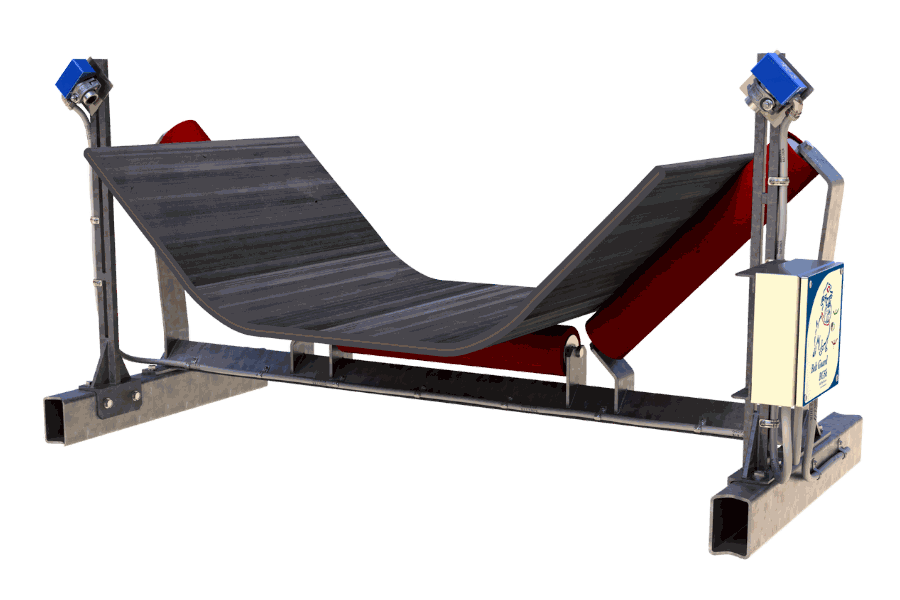
Two sensors are permanently mounted on the conveyor structure, one measuring each belt edge position. They continuously calculate belt width in real time. An operator-set tolerance window defines the acceptable range. Normal belt wander does not trigger a response because belt width remains constant during lateral movement.
01
Monitor
Two sensors continuously measure the position of each belt edge, calculating belt width and lateral tracking position in real time.
02
Detect
When a rip causes the belt to widen, narrow, or fold, the measured width deviates beyond the operator-set tolerance window (Belt Width OK Window ±).
03
Halt
If the deviation persists beyond the configurable Fail Delay timer, a HALT signal is sent to the PLC via Modbus TCP or relay dry contacts, stopping the conveyor.
Detection Limitation
The BG5k requires a measurable change in belt width following a rip event. This width-change effect has not been noted on all occasions of ripping, particularly on thicker, laterally stiff steel cord belting. If no (or insufficient) belt width change occurs, the BG5k will not stop the conveyor. Contact Beltscan to discuss suitability for steel cord applications where this limitation is a concern.
Technical Features
Capabilities
Non-contact belt-width monitoring
Works on fabric, PVC, and steel cord belting
Continuous real-time belt tracking in mm
Any belt width — no limitation
Any belt speed — no limitation
Any product type on belt
Automatic buildup detection sensors with blocked probe alert
Adjustable Belt Width OK Window ±
Configurable Fail Delay timer
HALT output via Modbus TCP or relay
Belt tracking via Modbus TCP/IP or 4–20mA
No sensor loops or antennae required
Belt manufacturer independent
Retrofit to existing conveyor structures
System Components
What's Included
Sensing Probes
2× buildup-detecting probes with mounting hardware
Sensor Mounts
2× mounting hardware for conveyor structure attachment
Main Electrical Enclosure
316 SS, IP66/IP67, all control electronics and PLC interface
Specifications
Technical Data
| Parameter | Value |
|---|
| Belt Type | Fabric, PVC, Steel Cord |
| Belt Width | No limitation |
| Belt Speed | No limitation |
| Contact | Non-contact |
| Sensors | 2× non-contact (buildup-detecting) |
| Power Supply | 100–240VAC 50/60Hz or 24VDC |
| Power Consumption | 120W max |
| Communication | Modbus TCP/IP or Control Cables |
| Belt Tracking Output | Modbus TCP/IP or 4–20mA |
| MEE Enclosure | 316 SS, IP66 (Manual) / IP67 (QSG) |
| MEE Size (Manual) | H400 × W300 × D250mm |
| MEE Size (QSG) | H600 × W400 × D200mm |
| Operating Temp | -25°C to +70°C |
| Storage Temp | -40°C to +80°C |
| Humidity | 5–95% RH |
| Default Width Window | ±50mm (factory set) |
Deployment
Installation
Location: 10–20m after each load point in the carry path. Multiple units recommended on conveyors with several load points. The closer the sensor to the load point, the shorter any resulting rip.
Installation: Performed by site personnel from detailed wiring and mounting specifications. Consists of sensor mounting hardware and PLC connection. Typical 1-day installation and commissioning.
Calibration: Belt Width OK Window must be set after measuring the normal width variation over a full belt revolution. The factory default of ±50mm may require adjustment to prevent false tripping.
Maintenance
Ongoing Requirements
The BG5k requires very little maintenance. Sensors are buildup-detecting when powered. If a sensor becomes blocked, the device reports an unhealthy state and de-energises the HEALTHY relay. An audible buzz from each sensor confirms operational status.
If cleaning is needed: hose down or wipe the sensor face with an alcohol wipe. The MEE should be protected from direct sunlight and aggressive hose down.
Applications
Where It's Used
Coal Handling
Grain Terminals
Aggregate Processing
Cement Plants
Port Facilities
Fabric Belt Conveyors
PVC Belt Systems
Multi-Load-Point Conveyors
Particularly suited to fabric and PVC belt operations where sensor loop systems cannot be used, and as a secondary rip detection layer on steel cord systems.