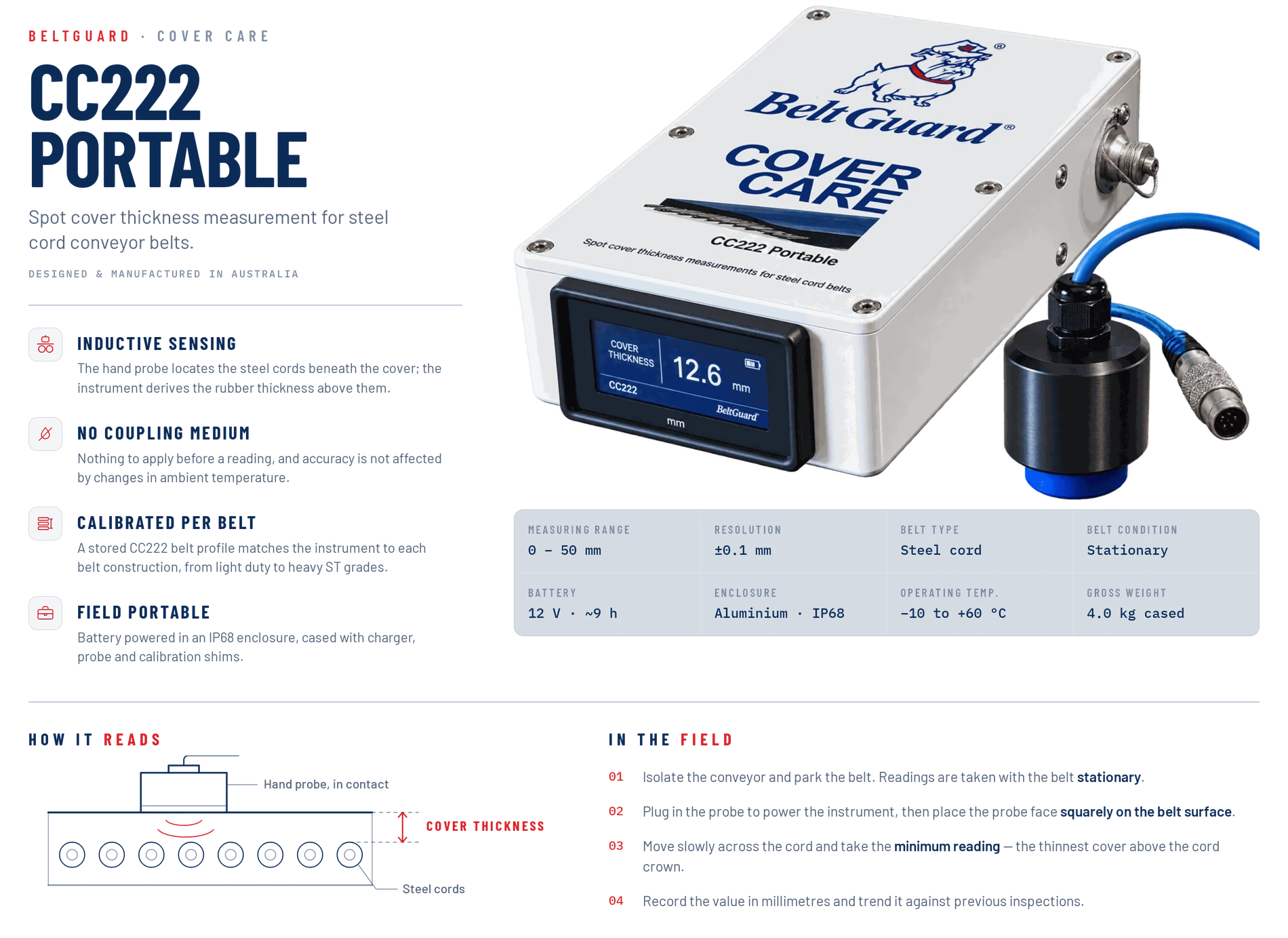
System overview — click to enlarge and read full detail.
CC222
Cover Care Portable
The Belt Guard Cover Care CC222 is a fully portable instrument for spot measurement of remaining cover thickness on steel cord conveyor belting. An inductive hand probe is placed in contact with the belt surface and detects the steel cords beneath the cover; a microprocessor calculates the distance from the probe face to the tops of the cords and displays it in millimetres. Unlike ultrasonic instruments used for the same purpose, no coupling medium is required and measurement accuracy is not affected by changes in ambient temperature. The belt must be stationary at the time of measurement.
All prices shown in USD. Indicative equipment pricing only. Final pricing may vary by belt width, configuration and destination. Freight, local taxes, installation and optional services are additional where applicable.
Is CC222 Right for Your Belts?
- Run steel cord belting and need remaining cover thickness
- Want spot measurements taken by your own people during a shutdown
- Want readings unaffected by ambient temperature
- Want to avoid the mess and cost of a coupling medium
- Want a portable instrument rather than a fixed installation
- Need cord and splice condition monitored — see Belt Scanner MF
- Need rip protection — see BG5k
- Need continuous or automated measurement
- Run fabric or PVC belting, which has no steel cords to measure against
How CC222 Works
Select the Belt Profile
Load or select the correct belt construction / calibration profile for the belt being measured.
Stop and Isolate the Belt
The CC222 is a handheld spot-measurement instrument used on a stationary belt. The conveyor and any associated machines must be isolated and all site safety requirements met before measurement.
Place the Probe
Position the probe squarely on the required measurement location. Because minimum cover is usually what matters, the probe is moved over an area to confirm the lowest reading.
Read Remaining Cover Thickness
The instrument measures and displays remaining rubber cover thickness at the selected location in millimetres.
Measurements can be recorded and compared over time to monitor wear.
What It Measures, and What It Doesn't
- Remaining top cover thickness above the steel cords, in millimetres
- Spot measurements at any accessible point on a stationary belt
- Wear trends over time when readings are logged and compared
- Assess cord or splice condition — See Belt Scanner MF →
- Provide rip protection — See BG5k →
- Measure fabric or PVC belts, which have no steel cords to read against
- Measure while the belt is running — the belt must be stationary
What Does Measurement Involve?
| Belt state | The belt must be stationary. The conveyor and associated equipment must be isolated before measurement. |
| Operator | Site personnel. Training is provided at handover. |
| Coupling medium | None required. |
| Temperature | Accuracy is not affected by changes in ambient temperature. |
| Belt profile | A stored CC222 belt profile matches the instrument to each belt construction, from light duty to heavy ST grades. The correct profile is selected before measuring. |
| Installation | None. Fully portable handheld instrument. |
| Power | 12 V 1.3 Ah battery, approximately 9 hours endurance. Charger supplied in the case. |
| Calibration | Calibration shims are supplied with the instrument for field checks. |
| Operating temperature | −10 to +60 °C |
ApprovalBuilding the Case Internally
The engineer who wants the system is rarely the person who approves it. These are the figures an approver will ask for — worth assembling before the conversation.
Steel cord belting, freight and installation for the affected conveyor
Hours to source, transport, splice and recommission after a failure
Throughput value or contractual exposure for each hour the conveyor is down
Expedited freight, out-of-hours labour, contractor mobilisation
Periodic inspection labour and the shutdowns it requires
Spillage clean-up, structural damage, safety and environmental reporting
Beltscan does not publish return-on-investment claims. The figures above are yours — we'll help you populate the system side of them.
ProcurementFor Your Procurement Team
| Supplier | Beltscan Systems Pty Ltd, ACN 614 321 309, PO Box 10457, Southport QLD 4215, Australia |
| Pricing currency | USD, indicative |
| Ingress protection | Powder-coated aluminium enclosure, IP68. |
| Gross weight | 4.0 kg cased |
| Supplied in case | Instrument, hand probe, charger and calibration shims. Case 330 × 130 × 280 mm. |
Track RecordProven in Conveyor Operations Worldwide
Belt Scanner technology has been installed on conveyors across Australia, Asia, Europe, North America and South America, in mining, alumina, steel, coal and bulk materials handling operations.
Customer names withheld. Reference sites can be discussed under NDA. Read the Western Australia alumina case study →
Frequently Asked Questions
Also in Belt Guard Range
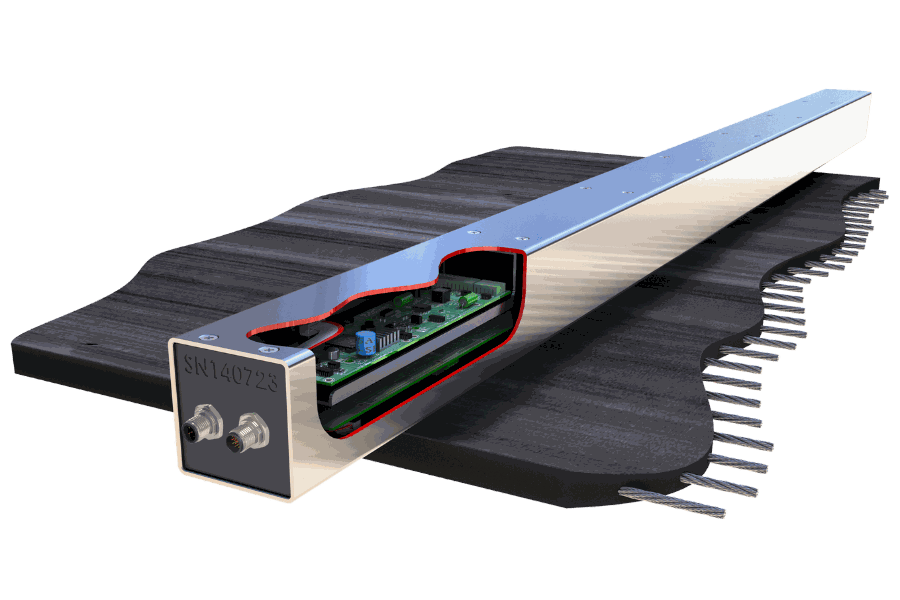
Permanently installed electromagnetic condition monitoring for steel cord belts, with optional automatic belt stop.
Portable electromagnetic scanner for multi-conveyor steel cord monitoring via slide-in tube assemblies.
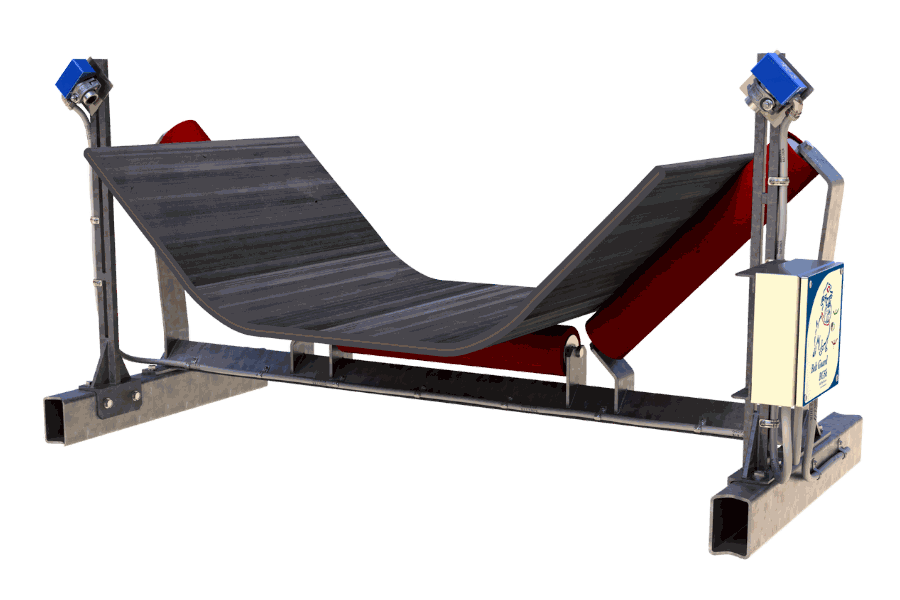
Longitudinal rip detection for fabric, PVC and steel cord belts, from continuous belt width monitoring.
Tell us the belt types you need to measure and we’ll quote the instrument, calibration shims and the belt profiles you’ll need to get started.