

Why BG5k?
Works on fabric, PVC and steel cord belting alike.
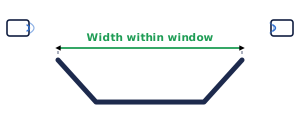
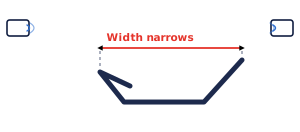
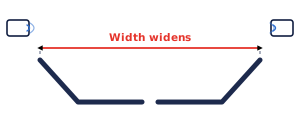
Belt width is monitored while the belt runs; a rip that changes it triggers an automated halt.
Real-time lateral belt position in millimetres — see developing mistracking early.
BG5k
Rip Detection for Fabric, PVC and Steel Cord Belts
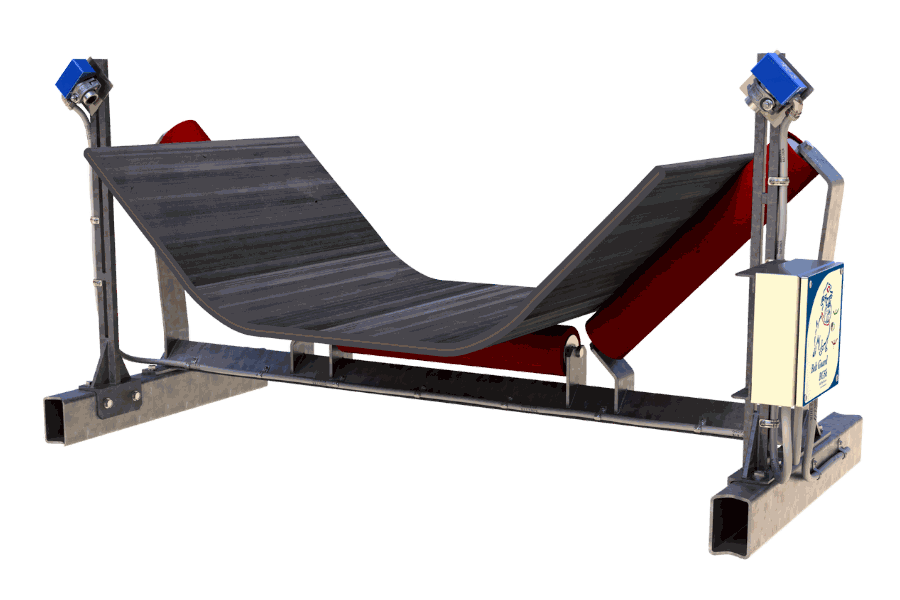
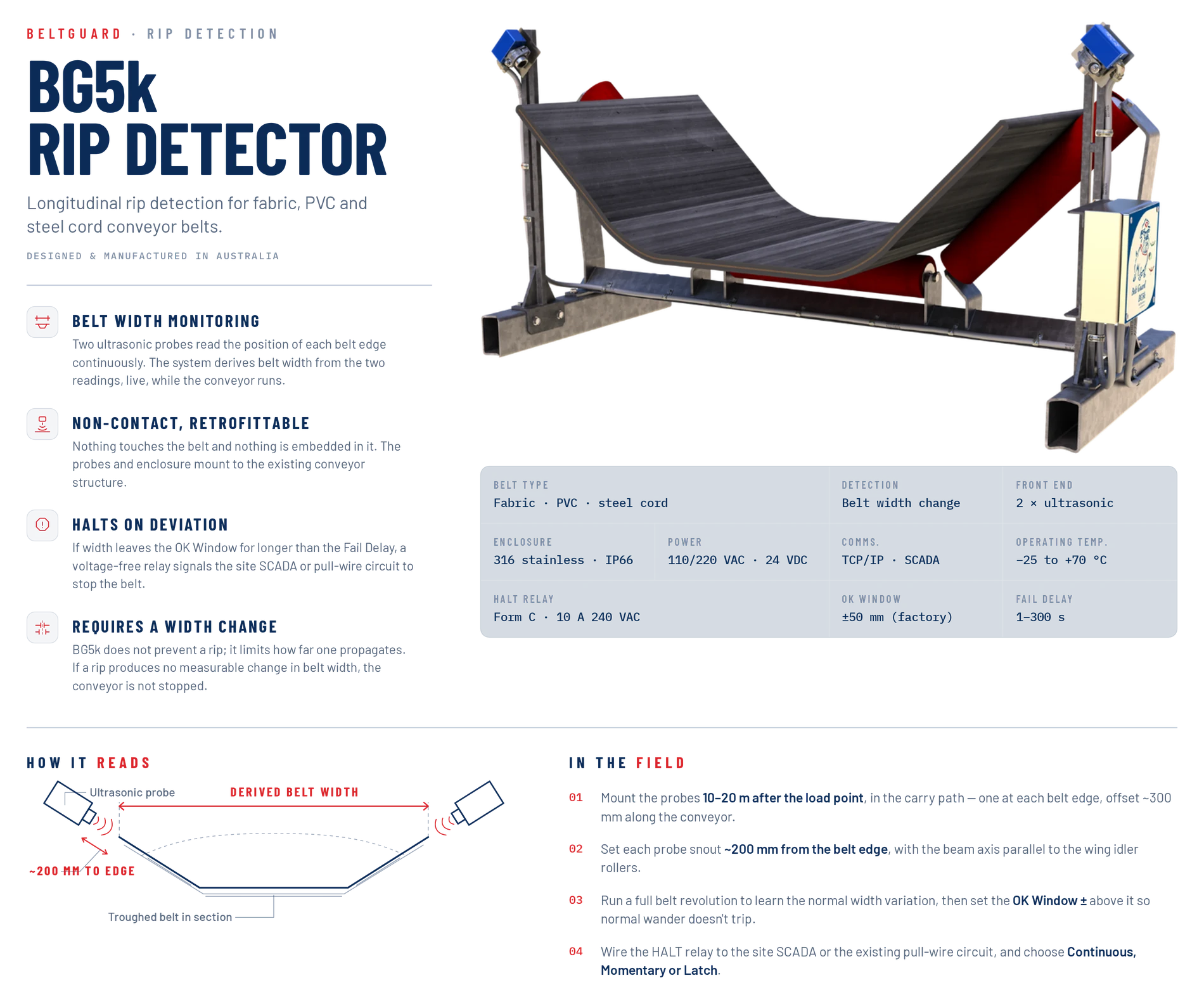
The Belt Guard BG5k is a longitudinal rip detector for fabric, PVC and steel cord conveyor belting. Two ultrasonic probes are mounted at the belt edges and read their position continuously; the system derives belt width from the two readings while the conveyor runs. When a rip opens or folds the belt and width moves outside the operator-set OK Window for longer than the Fail Delay, a voltage-free relay signals the site SCADA to stop the conveyor. BG5k does not prevent a rip — it limits how far one propagates. Nothing touches the belt and nothing is embedded in it, so it retrofits to existing conveyor structures.
BG5k systems are specified for your belt, conveyor arrangement, control interface and site requirements.
Supplied directly by Beltscan Systems or through authorised regional partners.
Is BG5k Right for Your Conveyor?
- Run fabric, PVC or steel cord belting
- Are exposed to longitudinal rip damage from trapped tramp material
- Want continuous, real-time protection rather than periodic inspection
- Want belt tracking monitored in millimetres at the same time
- Need to retrofit protection to an existing conveyor structure
- Need steel cord condition and splice monitoring — see Belt Scanner MF
- Need remaining cover thickness measured — see CC222
- Need surface defects found that don't change belt width
- Longitudinal rips that produce a measurable change in belt width
- Belt mistracking, measured in millimetres in real time
- Sensor buildup and blocked probes, reported automatically
- Stop a rip that produces no measurable change in belt width
- Assess steel cord or splice condition — See Belt Scanner MF →
- Measure cover thickness — See CC222 →
- Detect damage that does not change belt width or edge position
- Prevent a rip from starting — it limits how far one propagates
What BG5k Detects
- Longitudinal rips that change belt width
- Torn sections that fold or overlap
- Sections that separate or gape
- Developing mistracking, as lateral position in millimetres
- Excessive buildup on the sensor face
- Cord or splice condition — see Belt Scanner MF →
- Cover thickness — see CC222 →
- Rips that produce no measurable width change
- Damage while the conveyor is stopped
How BG5k Works
Measure Both Belt Edges
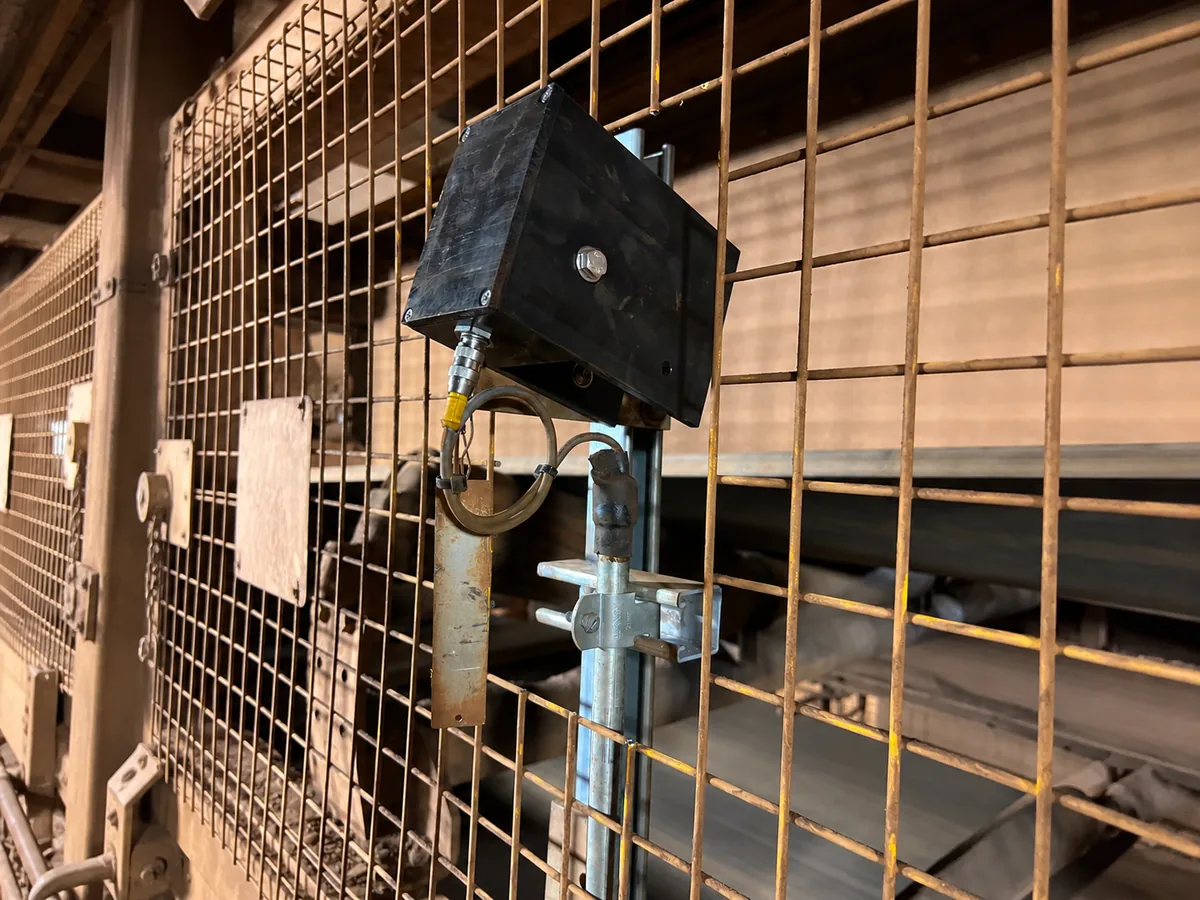
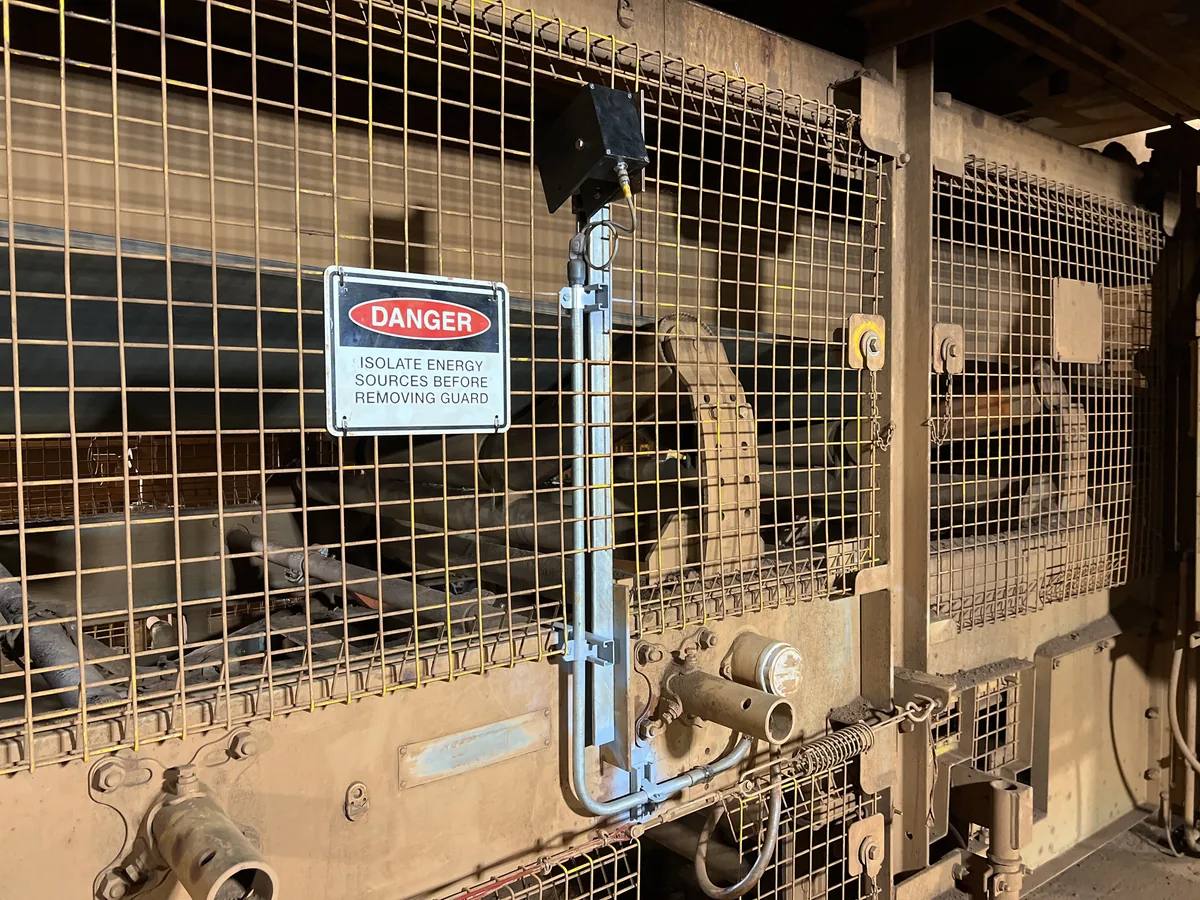
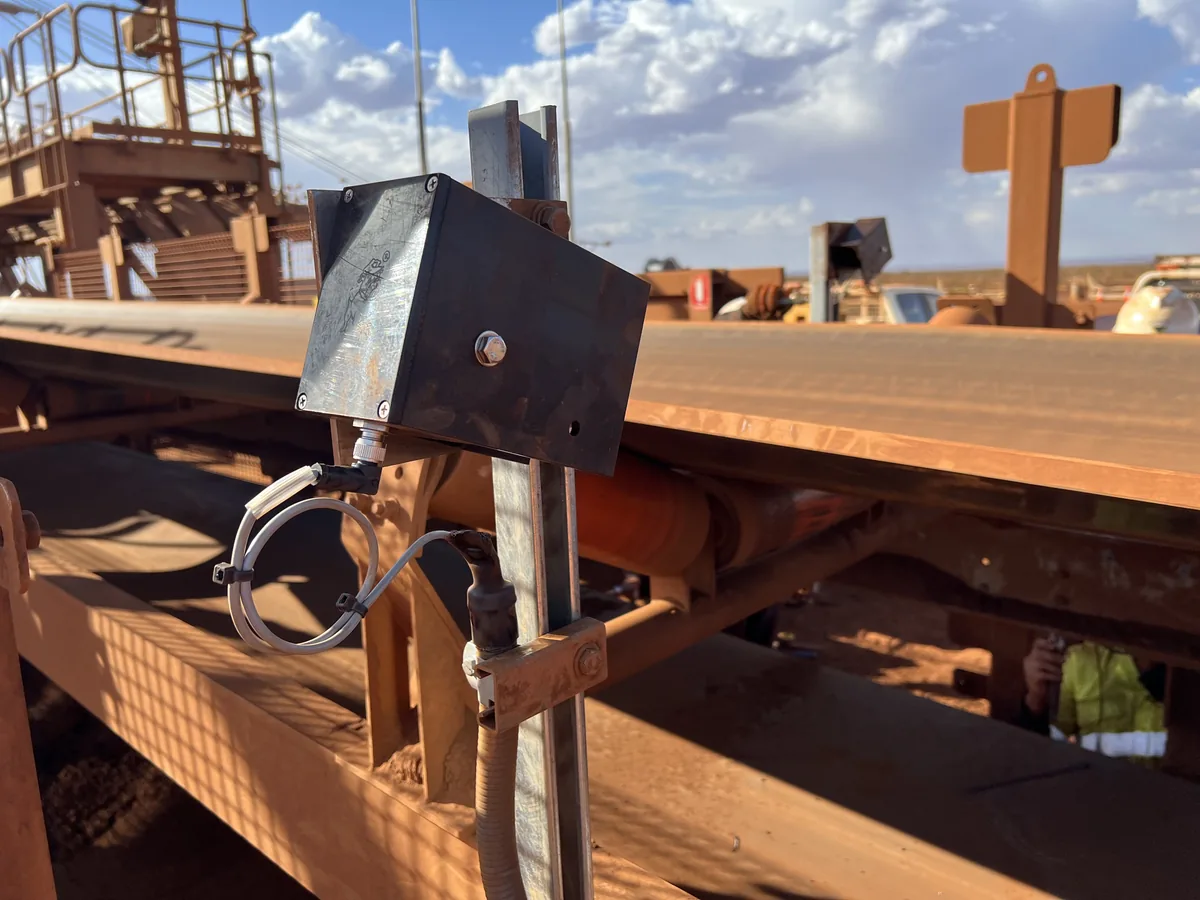
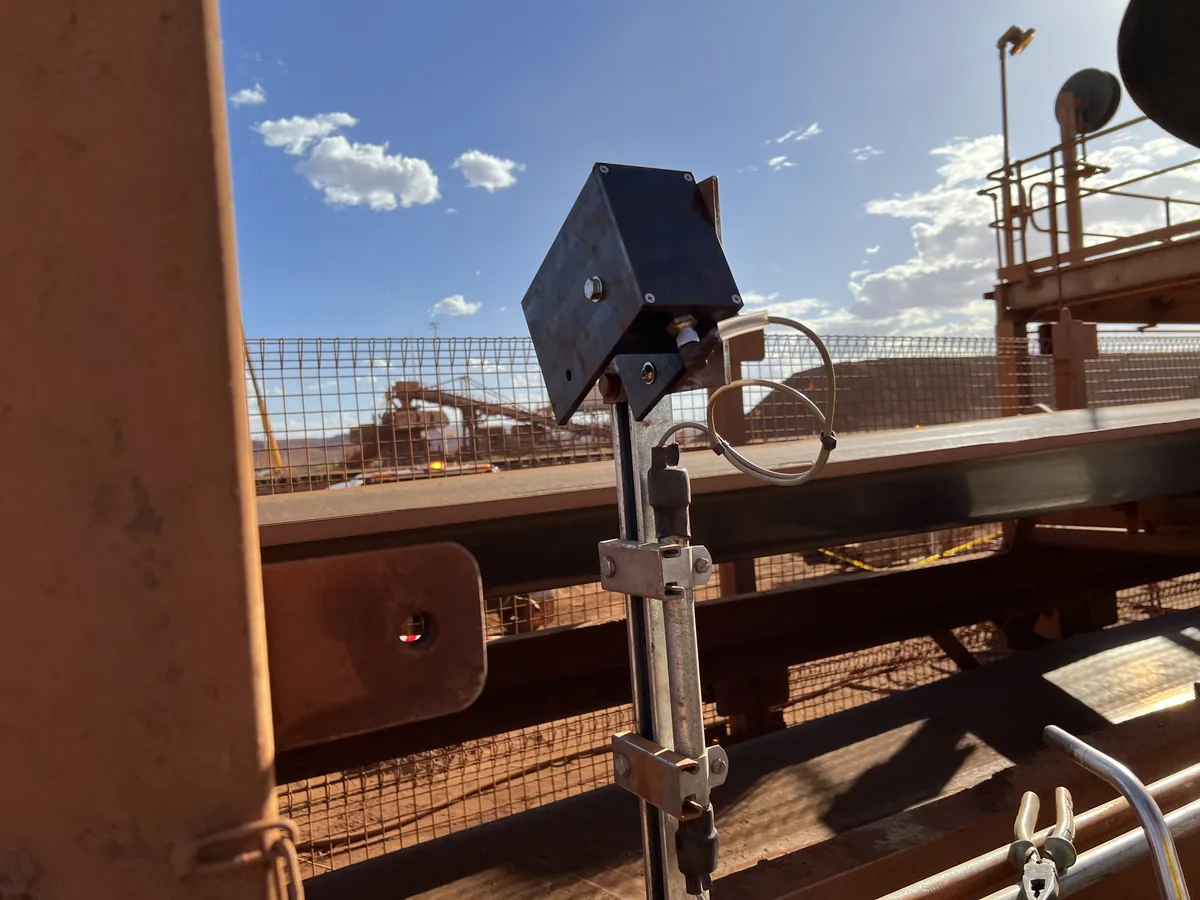
A non-contact ultrasonic probe is positioned at each edge of the conveyor belt.
Each probe continuously measures the position of its respective belt edge.
Calculate Width & Tracking
Using the two edge measurements, the BG5k continuously calculates:
- belt width
- lateral belt position / tracking
Detect a Rip-Induced Width Change
When a longitudinal rip causes the belt to widen, narrow, fold or otherwise produce a measurable change in belt width, the BG5k detects the deviation and initiates the configured response.
Warn or Stop
The BG5k compares measured width against configured limits. If the deviation exceeds the allowed threshold for the required duration, the system can issue:
- warning signals
- alarm outputs
- conveyor halt / shutdown signals to the site PLC
What Gets Installed
One monitors each belt edge.
Mounted close to the sensing location and connected to the probes and site control system.
Provides configured alarm and conveyor halt outputs.
BG5k in the Field
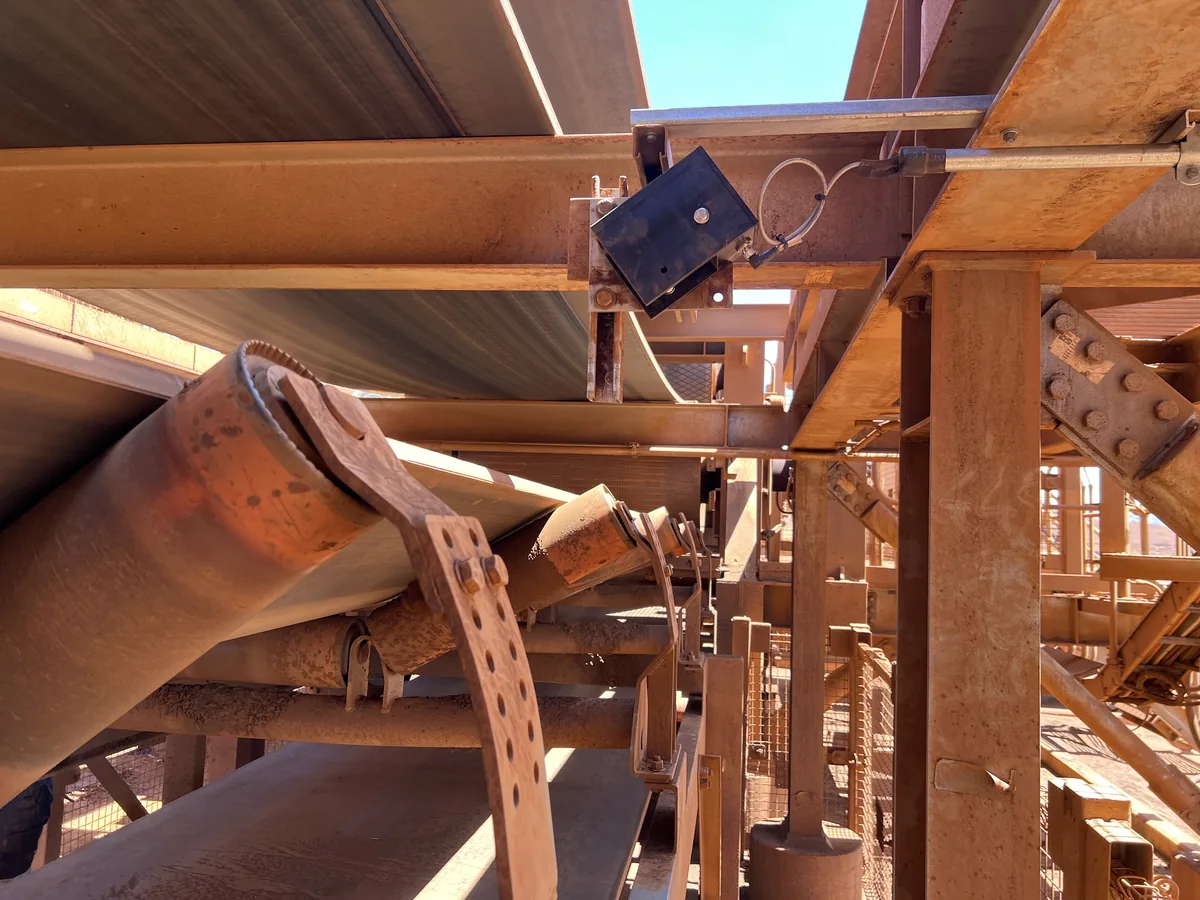
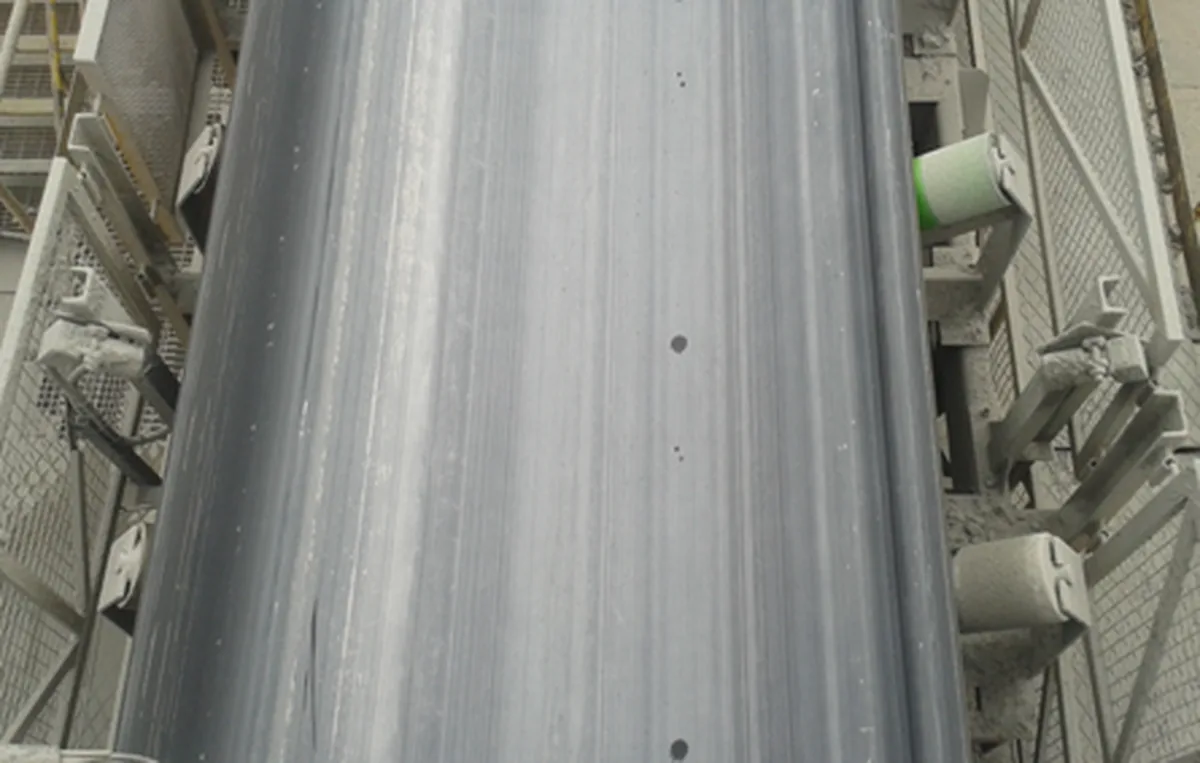
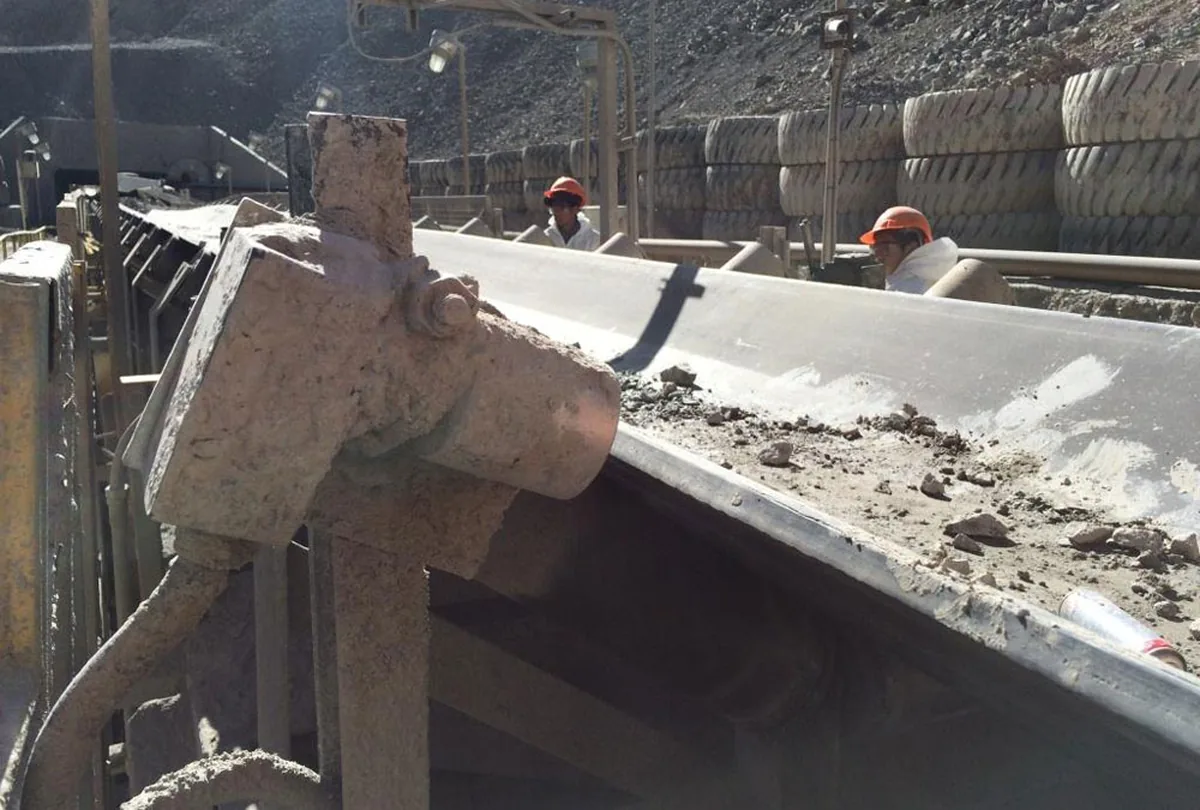
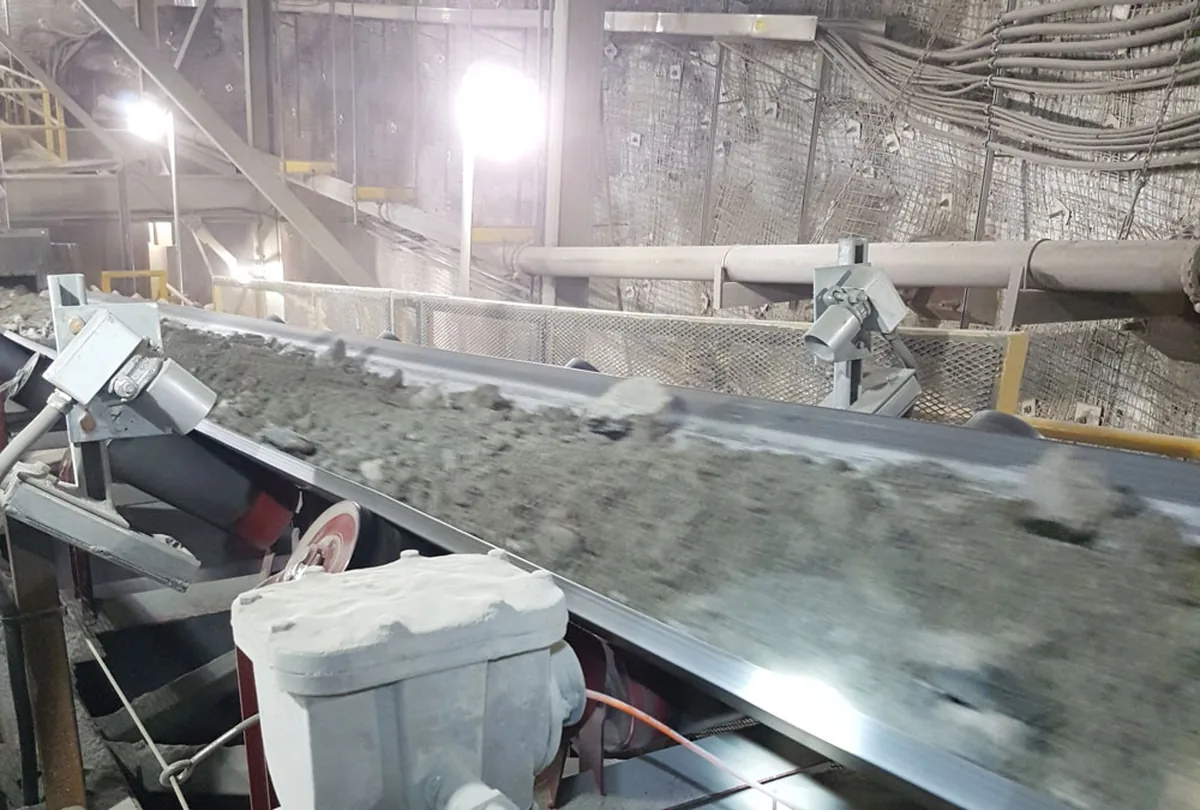
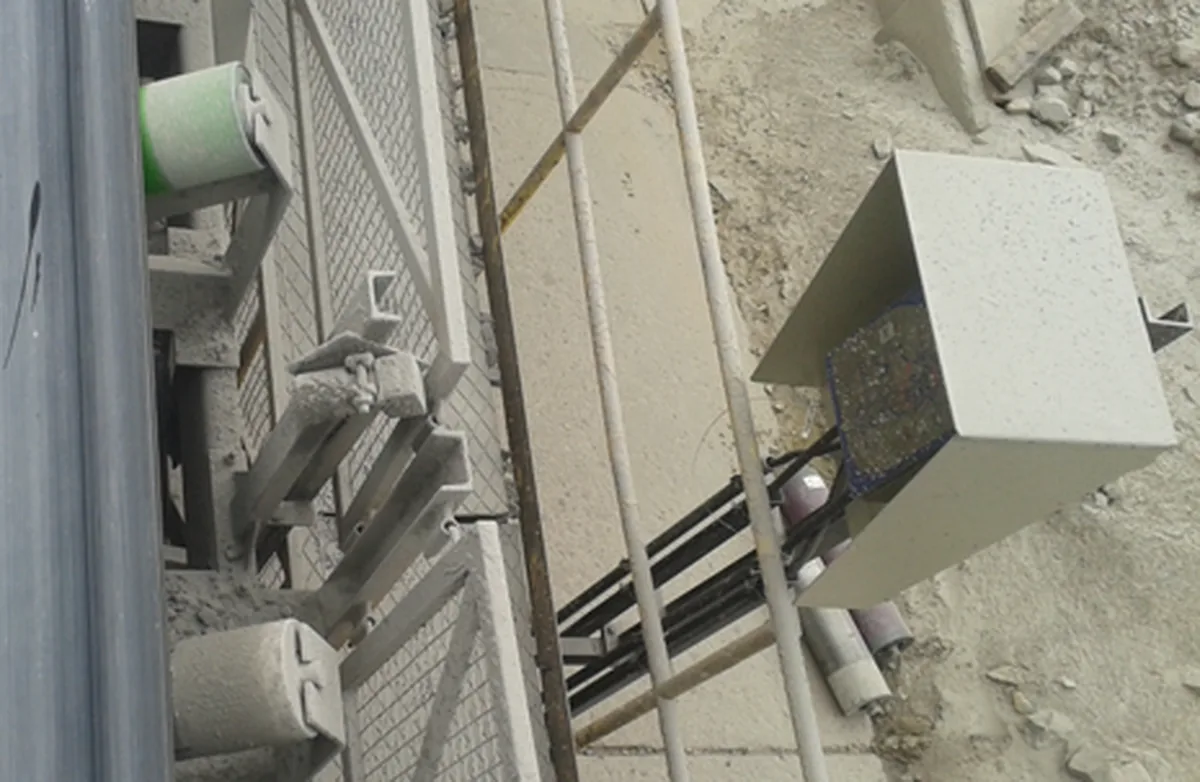
What Does Installation Involve?
| Installed by | Site personnel, following the supplied documentation with remote Beltscan support. |
| Retrofit | Yes. Mounts to existing conveyor structures. |
| Belt modification | None. No loops or markers are embedded in the belt. |
| Belt speed limits | Works at any belt speed. |
| Belt width limits | 600–3,000 mm per the Technical Bulletin. Contact us for belts outside this range. |
| Belt manufacturer | Not manufacturer dependent. |
| Commissioning | Run a full belt revolution to establish the normal width variation, then set the OK Window above it. Factory default is ±50 mm. |
| Power supply | 110/220 VAC 60/50 Hz, or 24 VDC by request. Approximately 10 W. |
| Control connection | Voltage-free Form C changeover relay contacts rated 10 A 240 VAC. HEALTHY status and HALT command wire to the site SCADA, or into the existing pull-wire circuit. |
| Conveyor shutdown | Required to fit the probe mounts. Probes clamp to site-provided mounts using a standard 48 mm scaffolding half clamp. |
| Network | Optional industrial CAT5E to the site network for remote adjustment and log download. Not required for the device to protect the belt. |
| Probe position | One probe per belt edge, offset about 300 mm along the conveyor so one probe cannot read the other. Snout about 200 mm from the belt edge, beam axis parallel to the wing idler rollers. |
| Front end location | 10–20 m after the load point, in the carry path. Fitted after the last load point where a conveyor has several. |
| Cable runs | Two runs of 20 mm poly-coated flexible steel conduit from the probes to the enclosure. Default length about 8 m and it cannot be extended, which constrains where the enclosure can sit. |
ApprovalBuilding the Case Internally
The engineer who wants the system is rarely the person who approves it. These are the figures an approver will ask for — worth assembling before the conversation.
Steel cord belting, freight and installation for the affected conveyor
Hours to source, transport, splice and recommission after a failure
Throughput value or contractual exposure for each hour the conveyor is down
Expedited freight, out-of-hours labour, contractor mobilisation
Periodic inspection labour and the shutdowns it requires
Spillage clean-up, structural damage, safety and environmental reporting
Beltscan does not publish return-on-investment claims. The figures above are yours — we'll help you populate the system side of them.
IT and OTData, Network and IT
| Network position | Optional industrial CAT5E connection to the site network for remote adjustment and log download. Alarm and halt signalling to the site SCADA is via voltage-free relay contacts, not the network. |
| Outbound traffic | None. There is no cloud or portal connection. Configuration and log download are via Belt Guard Boss – Client over the site network or a direct Ethernet cable. |
| Control path | HEALTHY and HALT relay outputs only, as configured at commissioning. |
| Data ownership | Data and event logs are held in non-volatile memory in the enclosure and can be downloaded on demand. |
OwnershipLiving With the System
| Calibration | No routine calibration. The device is zeroed at commissioning, and again if a probe is later moved further than 200 mm from the belt edge. |
| Belt replacement | Re-run a full belt revolution to establish the new belt's normal width variation and reset the OK Window. |
| Communications loss | The unit protects the belt standalone; the network connection is only used for remote access and log download. |
| Warranty | 12 months from date of dispatch against faulty parts and workmanship. |
| Probe cleaning | Probes are self-cleaning while powered. A blocked probe raises the Head Blocked Alarm and drops the HEALTHY relay rather than being read as a width change. Clean the probe face with an alcohol wipe. |
| Logs | Data and event logs are held in non-volatile memory in the enclosure and can be downloaded on demand. |
ProcurementFor Your Procurement Team
| Supplier | Beltscan Systems Pty Ltd, ACN 614 321 309, PO Box 10457, Southport QLD 4215, Australia |
| Commercial supply | Quoted by Beltscan Systems or the authorised regional partner for the project location. |
| Ingress protection | 316 grade stainless steel enclosure, IP66. Keep it out of direct sunlight and heavy hose-down; additional site-compliant enclosures can be added. |
| Enclosure size | W 37 × D 23 × H 37 cm |
| Operating temperature | −25 to +70 °C, 5–95% RH |
| Storage temperature | −40 to +80 °C, 5–95% RH |
Track RecordProven in Conveyor Operations Worldwide
Belt Scanner technology has been installed on conveyors across Australia, Asia, Europe, North America and South America, in mining, alumina, steel, coal and bulk materials handling operations.
Customer names withheld. Reference sites can be discussed under NDA. Read the Western Australia alumina case study →
System Supply & What’s Included
- 2 × non-contact sensing probes with mounting hardware
- Sensor mounts for conveyor structure attachment
- Main electrical enclosure — control electronics and PLC interface
- PLC / SCADA interface capability
- BG5k configuration software — thresholds, alarms and outputs
- Installation, wiring and operating documentation
- BG5k system configuration
- Threshold, alarm and output settings
- Adjustable at commissioning and any time afterwards
- Configuration and event access
No recurring BG5k software licence is required.
Each BG5k system is quoted for the application. Final configuration depends on conveyor geometry, belt arrangement, control integration, destination and any site-specific installation or support requirements.
BG5k systems are supplied internationally through Beltscan Systems and authorised regional partners.
Frequently Asked Questions
This page covers what the system does. The detection logic behind width-based rip monitoring is explained in more depth in our technical article.
Technical Resources
Read the Canadian underground BG5k case study →System Overview
Also in Belt Guard Range
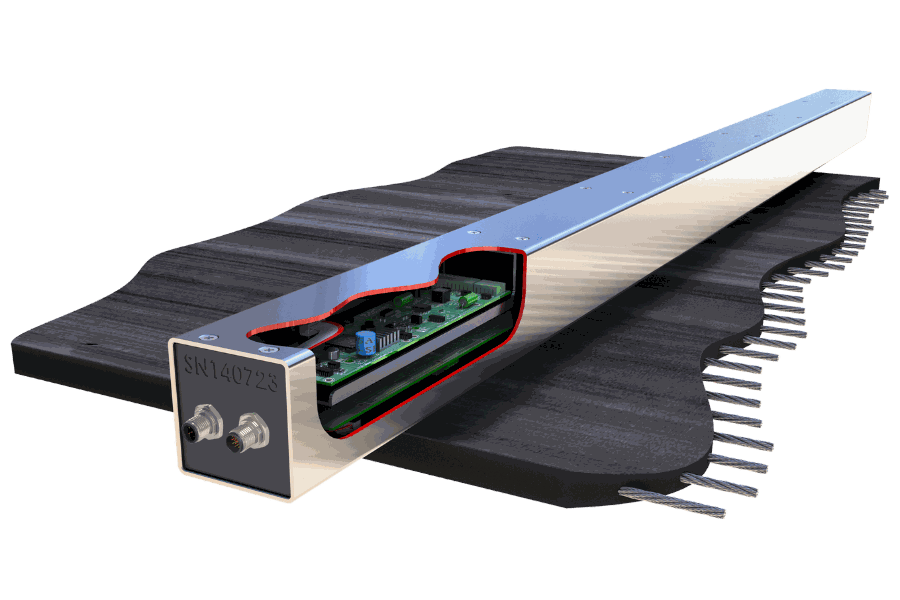
Permanently installed electromagnetic condition monitoring for steel cord belts, with optional automatic belt stop.
Portable electromagnetic scanner for multi-conveyor steel cord monitoring via slide-in tube assemblies.
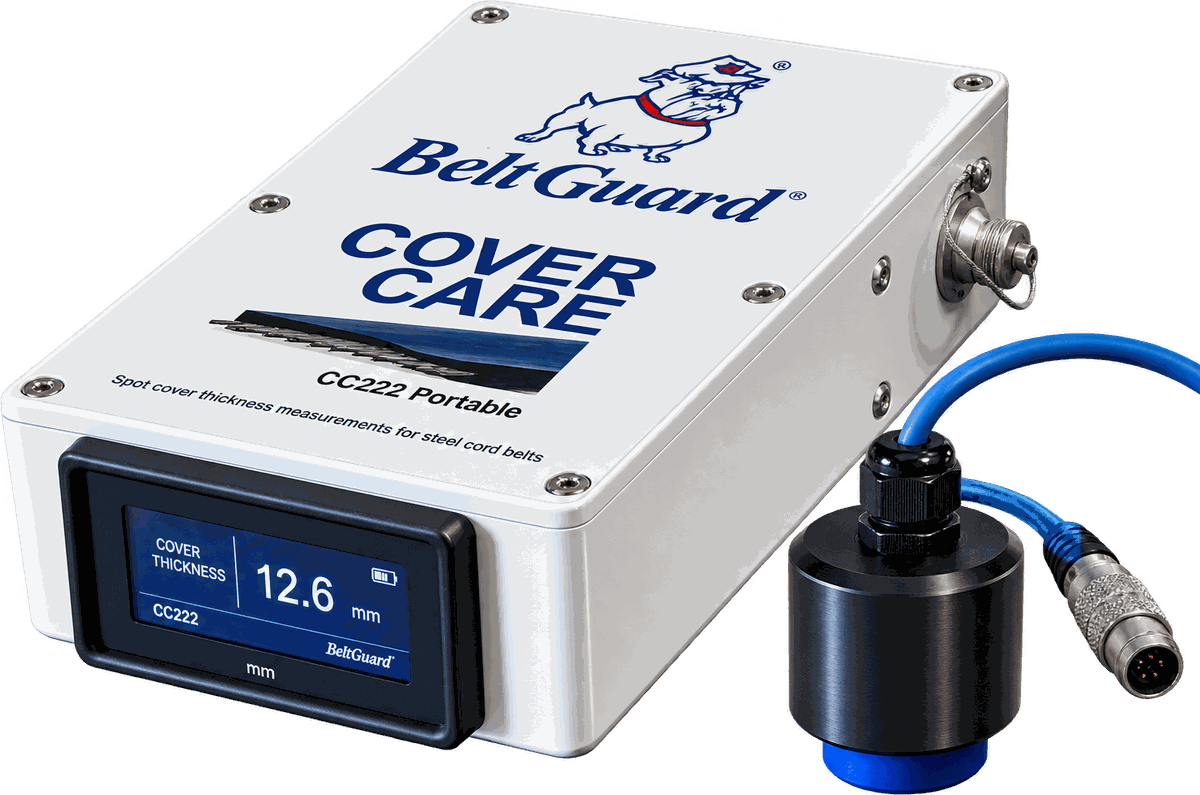
Handheld contact instrument for measuring remaining belt cover thickness. No coupling medium required.
Get a Recommendation
Tell us about your conveyor and application. We’ll recommend the appropriate BG5k configuration and sensor arrangement, then provide a project quotation through the appropriate Beltscan sales channel.